An AI Designed a Molecule. Now What?
This article is adapted from a life science panel at Granite Asia’s annual meeting in Singapore. All quotes have been edited for clarity and brevity.
Traditionally, drug discovery begins with a biological target. Read: A protein or pathway that researchers and scientists think they can influence to treat a disease. Teams then look for molecules that can act on this pathway, make and test promising designs, and refine them through iteration. A candidate that survives the repeated rounds of experiments still has to pass further safety testing and clinical trials.
But AI is changing the early part of the process. For a hot minute, the most interesting question in AI-driven drug discovery was, could a model design a molecule worth making? Increasingly, the answer is a resounding YES. Joshua Wu, Managing Partner at Granite Asia, notes, “New models are designing molecules that have never existed before, and the process now takes just weeks instead of months or years.”
The more interesting question is what comes next. A molecule can look promising on a screen, but that doesn’t mean it can be made easily, behave as predicted, or that it will ever become a drug treatment for a disease. As Joshua puts it, “Having a great model is only a starting point. The lasting advantage comes from the loop between the AI model and tests in the lab.”
This is the less glamorous (and maybe more consequential) reality of AI-driven drug discovery. As models get better at proposing candidates, scientists and researchers still have to find out what these molecules actually do. It becomes a loop: Make the molecule. Test it. Work out whether the result is real or a fluke. Decide what to change. And then begin all over again.
I am Speed
Earendil Labs develops antibodies designed to engage two or three biological targets at once. The CEO, Peng Jian, says the company’s combination of AI design and high-throughput biology* can bring a molecule to the point where it’s ready for manufacturing and toxicology studies within a year. “The traditional approach will take maybe three years to get a molecule that’s ready to get into the manufacturing and toxicology studies. With Earendil’s approach, we can shorten that time to within a year.”
Peng Jian credits this speed to both “fast iterated, high-throughput biology” as well as “quick AI design”, not design alone. Even the best case for faster design encompasses a narrative about what happens in the lab.
As designs arrive faster from AI, a new question pops up: How do you test enough of them to know which molecule deserves to move forward?
*Methods that let the Earendil Labs team test many candidate molecules at the same time, and use the results to guide the next round of designs.
Into the Lab: More Designs, Better Experiments
Aureka’s answer is to increase the amount of useful experimental evidence it can generate. Zhao Weian, CEO of Aureka, argues that, “AI is probably no longer the bottleneck here. It can design millions and millions of molecules, and the traditional wet-lab experiments have really become the bottleneck.” That’s why Aureka is building systems intended to test antibody sequences, then use the results to guide the next round of design. Sounds simple, right?
Well, it’s straightforward enough until you look closely at what an experiment involves. It’s not just a recipe that a machine can follow from start to end.
At MegaRobo, the challenge is getting automated systems to handle the instinctive decisions a scientist makes along the way. A good scientist doesn’t simply follow a protocol – they make hundreds of small decisions almost instinctively: Whether the sample is healthy, whether a signal comes from biology or from instrument noise, whether an outlier is an error or a discovery. “Most of this knowledge is not written into the protocol,” Daniel Huang, CEO of MegaRobo, shares.
Connecting digital intelligence to reliable physical execution is still extremely hard. “Moving the liquid is easy,” Daniel says. “But understanding the liquid is difficult. The motion is easy, but the science is hard.”
Make no mistake – robots can indeed help a lab do even more. But the even harder task is making sure the work produces results that scientists, and eventually, AI models, can interpret and trust.
They Hit, They Score!
A successful experiment teaches you something, but don’t throw away the misses! Because you can learn from an unsuccessful one, if you keep enough of the data.
That’s BioMap’s approach. Xu Ziyao, President of BioMap, describes a gap in how biotech companies handle their data. An experiment may produce tens of thousands or even millions of data points, but companies typically record only the one or two hits that move forward. “BioMap’s platform records all of it, converts the raw lab data into data usable for machine learning, and uses our foundation model to build task-specific models on our customer’s historical data,” Ziyao explains. Those task-specific models then generate the next round of designs, meaning that the more a customer uses BioMap, the better the designs and R&D efficiency.
This approach shapes BioMap’s business model. “What we provide is not a single pipeline,” she notes. “We want to provide them with a platform.” This platform is one where customers can build their own AI capabilities and pipelines.
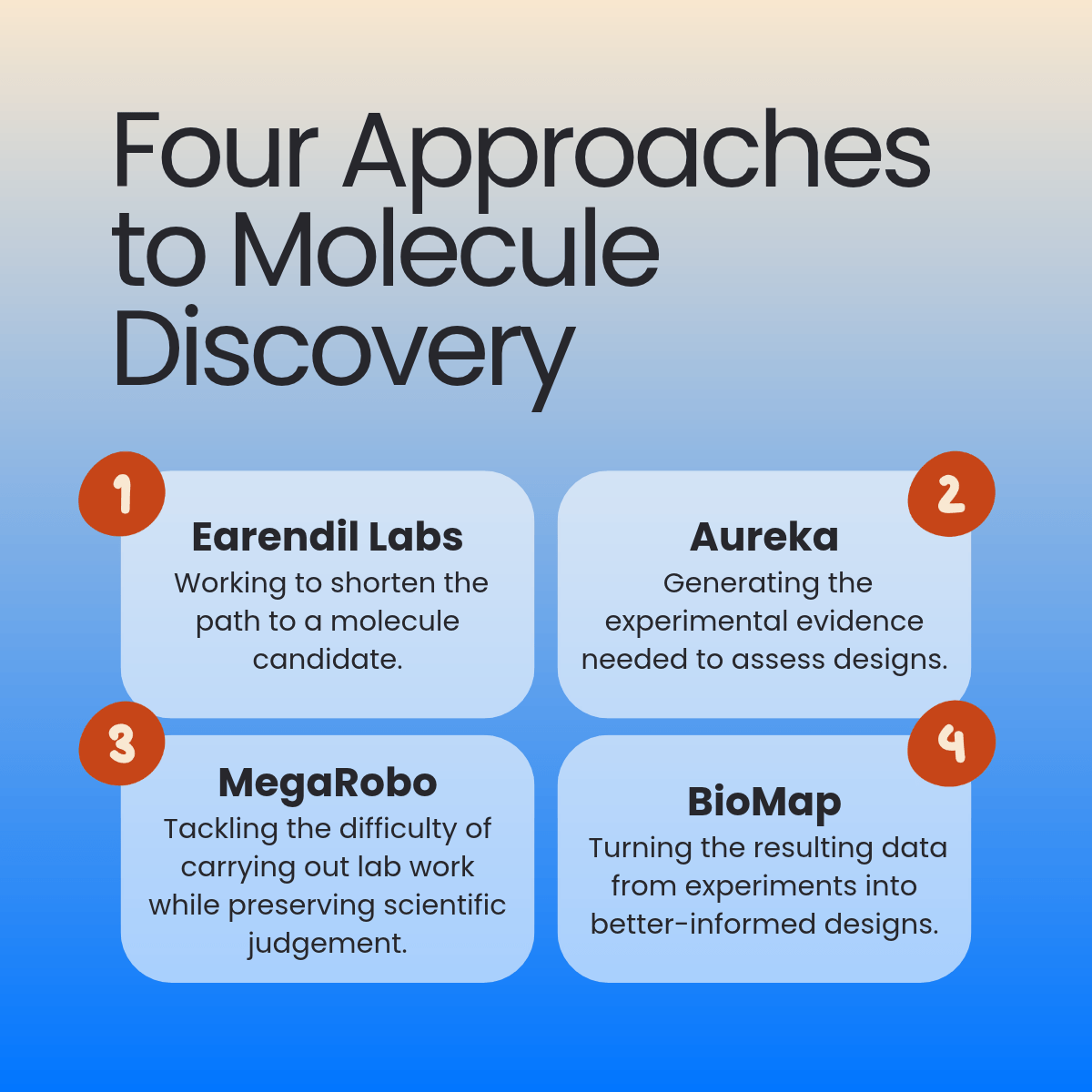
A more interesting picture emerges with four different approaches to different parts of molecule/drug discovery.
Proceed with Caution
It may be tempting to call any cycle of design, testing, and new design a self-improving loop, but biology is built different. It’s less obliging, experiments take time, and results can be… noisy. Peng Jian cautioned that the kind of autonomous self-improvement often discussed in AI is not yet developed in life sciences, “Self-improving models are not there yet and we’re still at the data accumulation stage. We’re perhaps three to five years from anything like it.” Generating and validating the necessary data is going to take longer in biology.
“How many molecules can this model design?” is no longer a useful question. What’s more useful:
- How many designs does it take to find a validated hit?
- Can another team or another experiment reproduce the same result?
- Does what the system learn in one round improve its decisions in the next?
- Do these decisions in molecule design hold up beyond the discovery lab?
An AI-generated or AI-designed module is a hypothesis, a starting point. Progress within the realm of AI for Science needs to show more than just good ideas – companies, scientists, and researchers need to learn, reliably, which of these good ideas survive contact with actual biology.
Share this post:


Where to find us:
Guoco Midtown
128 Beach Road #21-02
Singapore, 189773
