Why XPENG Is Building Humanoid Robots
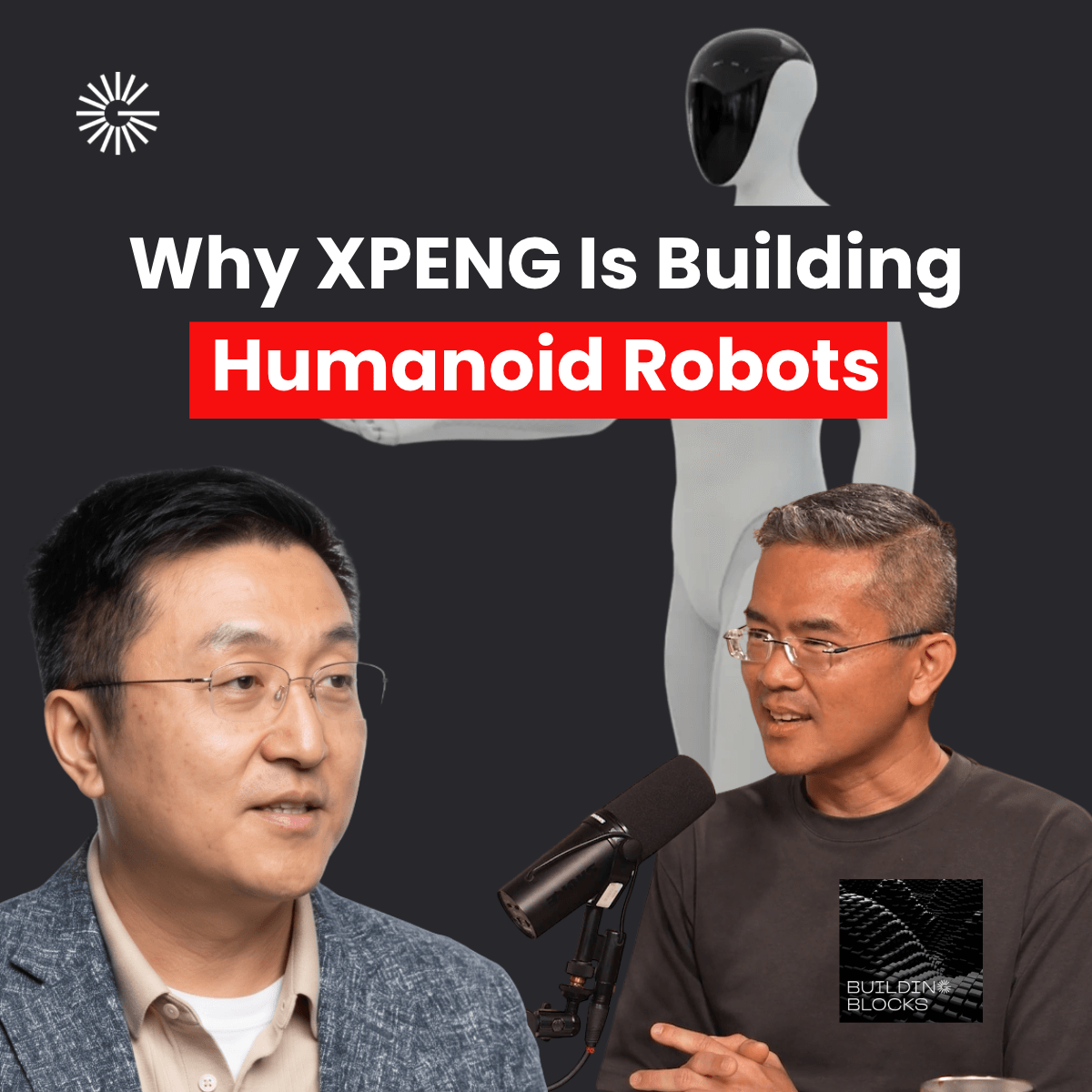
Why would a carmaker build a humanoid robot? XPENG’s Vice Chairman and President, Brian Gu, explains how electric vehicles, AI models, and in-house chips became the building blocks (pun fully intended) for IRON, XPENG’s humanoid robot. And what it takes to build a supply chain for a category that does not yet exist.
IRON walked across a stage, and people thought there was a human inside. XPENG’s Chairman and CEO, He Xiaopeng, then cut open the robot’s leg in front of the media to show what was underneath. In this episode, we get into how a carmaker came to build a humanoid robot. Plus, what XPENG is building next.
This is the first episode of Building Blocks Season 2.
Episode Transcript
Chuen Hong (CH): So Brian, a warm welcome. It’s a real pleasure to have you with us today. Maybe I’m just gonna start by saying, you are a real idol as far as a lot of people are concerned, having been involved deeply in the tech ecosystem in your previous life in JP Morgan, having led many, many big IPOs. But I think what most people don’t realise is your actual background. Now, for those of you who are not familiar, Brian actually has a Bachelor’s in Chemistry from Oregon, if I got that correctly, as well as a PhD in Biochemistry. So Brian, maybe tell us a little bit. How did you start off by being a science geek in Biochemistry and then going on to be an investment banker? And then what prompted you to join XPENG?
Brian (B): Well, thank you, Chuen Hong. And very happy to be here. And the story was actually quite… straightforward. Our generation grew up in China. At that time, the best way to go abroad is to study science. So very early on, given my mother was an organic chemist. Even before I arrived in college, somehow my major is Chemistry.
CH: So had chemistry in your blood.
B: So it was pretty much automatic. But it was also a subject I enjoyed a lot. I always liked, you know, Math and Science. And also when I get to graduate school, the PhD, I decided to go for Biochemistry. I thought that’s cooler than just pure Chemistry. I think that actually was a very interesting background because I can look back and see a lot of the careers I was associated with, regardless whether it’s banking, or starting XPENG together with partners. I think having a science background really, really obviously helped. And also it’s a training that you will never forget in your lifetime. You’re trained to be analytical. You’re trained to be very good with solving problems. I think you retain a high level of curiousity. And at the same time, I think I didn’t completely give up the biochemistry side of exposure. When I was a banker, one of the sectors I spent a lot of my time on is healthcare and biotech.
CH: Oh, I see, okay.
B: And also even at XPENG, on the side, I still pretty much follow some of the latest development. Actually, my professor in Seattle is still working. So keep very close relationship. So yeah, think it’s something I think really helped sort of form the career perspective and very much part of who I am today.
CH: I was going to say because we were chatting a little bit just before this that I have a soft spot because I’m also a neuroscientist by training, so the whole biological field, but never really applied any of it. But indeed it was quite a, you know, that scientific curiosity and that rigour is at the core, so yes obviously then jumping to you know banking you know as a JP Morgan. But you were a very successful investment banker. Why did you decide to take that slightly uncommon path to join XPENG?
B: Wow. I mean, I think it was a fairly fateful decision. And that was in 2017. In fact, I I had been a banker since 1998. Altogether, I did 20 years of investment banking, 6 years in New York, 14 years in Hong Kong. And I actually, you know, in Hong Kong, saw really the development of the Chinese economy and the capital markets. The first wave of the state reform, then the real estate craze. You have the, after financial crisis, there’s a huge building boom on infrastructure. And then obviously the biggest wave is the tech platforms like Tencent, Alibaba, all the other emerging tech companies. I actually got a lot of valuable experience working with those companies. I worked on the Alibaba IPO, the banker who gave probably the first financing to Xiaomi when they were very, very young. And also all the other tech names I pretty much had a lot of working experience with. So I witnessed how entrepreneurship really happened in the Chinese economy. So… By 2017, I think there is a little itch that, okay, saw the rise. Is this something I should try for myself? So that was the first factor. But the second factor really is to find the right area where you see huge changes coming. Every year at that time, I go and attend the CES in Las Vegas.
CH: This is while you were still at JP Morgan?
B: It was when I was at JP Morgan because I did a lot of tech deals. So I went to CES, obviously check out the latest development. You know, in 2015, 16, 17, every year, I start to realise there’s an interesting phenomenon. There’s a big convergence between the tech world and auto world. A lot of the traditional consumer electronics company has a separate exhibition on automotive applications. So that got me thinking, there’s something happening in that segment. And obviously Tesla, you know, starting to make waves in those years. So I think I also saw a huge opportunity where one of the largest sectors in the world is being disrupted massively, both energy transition as well as the convergence of tech and automotive. So that’s the second factor. But the most important, I think the critical factor is I actually was approached by a friend of mine. His name is He Xiaopeng. We know each other for a few years already by then. We, have been personal friends, never done any business together, even though he was a successful entrepreneur.
CH: Very successful.
B: Yeah. And he actually also has been invested into very interesting businesses, including the EV company called XPENG. He was investor at that time, but in 2017, he came to my house and we had a chat on the rooftop and he said, “Oh, Brian. I’m thinking about leaving Alibaba.” At the time, he was the president of the mobile group. So I’m thinking about going to run this company. I invested myself as a Chairman/CEO and I was thinking about it. I need someone, you know, as a partner with your background, you know, do you want to consider it? So that got me thinking. In the beginning, it was a very unlikely decision. I asked him three questions. Okay, the company you’re going to, XPENG, which I know a little about. How much money is raised? Where is the car, and is there a factory or store that we have to build a business? So his honest answer is they have not raised a single round of financing yet. The prototype is still being worked on, so nothing to really show for. And obviously no factory, no store, or even time to even think about them. So I was thought, you know, it’s probably a little bit too early. But anyway, he went in as a Chairman/CEO in August 2017. And I start to watch and follow him closely. We maintained a very strong dialogue and I can start to see he making big changes to that little business. He’s bringing incredible management, raised the first round. So I started thinking, this guy has something, he obviously has a track record of being a successful entrepreneur. And with all the other factors I mentioned, saw, you know, and also the pull factor and push factor together. I think maybe it’s something, you know, I can do it. At that time, also I was 45 years old. I thought to myself is, you know, it’s something I need to try. If I don’t do it, then probably I’ll stay in banking for the rest of my career. So I think it just, very, I would say, it’s a conviction that you made quickly. It’s not something you can over-analyse it. It’s just something you have to follow your impulse.
CH: I think Mr. He Xiaopeng is actually extremely visionary in many, many, many ways. And I think to be able to work with somebody like him, I think must have been quite an opportunity. But I’m just very curious. Did he have to buy you another dinner? Did he have to give you more wine before you decided? Or did he have to say something that really tipped the balance for you to join?
B: Well, I think, you know, he already presented a very interesting vision at that time. I think we want to build something different, right? You know, it’s a very different approach because other startups in the EV world also have, you know, regular dialogues with me, right?
CH: I know you must’ve been courted by quite a few.
B: Yeah. Also, because of my role in JP Morgan, I’ve been approached by pretty much every startup at that space. So I actually saw them and I compare it to Xiaopeng. I think Xiaopeng has something different. The way he think about the future, the way he put intelligence in front of electrification, the way he think about technology before automotive, the way he think about global. All has really put him in a completely different league. So I think, it was a very impressive vision and plan. But he never really, you know, hard sell. I mean, I think it was a conversation that, also it’s part of me who said, okay, I want to do something. I want to do something different. I want to try it. because there’s a lot of opportunity for a banker to be a CFO of an established company and a lot of big companies actually, you know, had these conversations with me. But I don’t want another job. I want to feel like I’m building another company. It’s really the entrepreneur experience that’s got me excited about. It’s not, you know, just being, you know, executive in another big tech company. So I think that’s the thinking process and also ultimately, I think it’s a very natural decision. It’s not something that you have to, you know, consider trade-offs. It’s just, okay, that’s something what’s doing.
CH: Well, I’ll come back to this at the very end and just for the audience, a little bit of a cliffhanger. I think Brian, your motto is no regrets, if I understand that correctly. So I’ll come back to this a little bit later. But you talked a lot actually and gave us a sense of how XPENG was quite different. It was quite a different league. And it’s a great segue because I wanted to ask you: in EVs, and it’s not really about the model. XPENG has a wonderful G6 and the X9. It’s not about the model. But back then, I think it was 2014, 2018, it was creating a brand new category. Now, a lot of the incumbent companies were probably, well, maybe somewhat dismissive. Some of them, even if they were interested, thought of this as just a different drivetrain. But I suspect XPENG looked at it a little bit differently. So maybe tell us what was it that was different and what was this new category-creating idea behind XPENG?
B: Yeah. Well, I mean, just look back, when we have the first investor and presentation materials to investors. We actually have a tagline, which I used, you know, several years ago.
CH: This is just before IPO?
B: That was way before IPO. It was like 2018. That’s when I joined. And also, that’s when we first started have, you know, real sort of a thoughtful sort of a material to talk about a story. I think one of the things that we’ve been very consistent is that we don’t think the long-term differentiation in the mobility world comes from electrification. The differentiation is from intelligence. That’s way before people talk about AI. That’s way before people talk about autonomous driving, you know, robotaxi. I think people at that time still are thinking about EV as different.
CH: Yeah, just more sort of green, you know, way of running a vehicle.
B: A lot of the players has come up with electric vehicle, right? Some of those are just simple conversion from the ICEs. But I think that, in our mind, we need to build a very solid and high quality and competitive EV. But in the back of my mind, we always believed that the long-term differentiation, what really sets apart redefining mobility is on the intelligence. That’s why I think it’s very interesting when I was thinking about joining XPENG, even before I joined, the first thing I did was, you know, go to Silicon Valley with Xiaopeng at the time of CES, after CES, we were there. The first thing is to set up a Silicon Valley office when we’re still very, very young company. Because that’s where the leading minds for software for intelligence are based. There’s a lot of autonomous driving talent. And then we think we need to invest even before we have an actual car, we need to invest in that technology.
CH: Because you were closer to the technology and the talent in the Silicon Valley?
B: Because we believe that, first of all, it’s one of the most important areas that we have to invest, we have to be a leader in. There’s no shortcut. Secondly is that if you want to be a leader, you have to be in Silicon Valley. Yes, I mean, a lot of other Chinese companies built software teams or autonomous driving teams in parts of China. They can do well and follow what’s going on globally, but to be one of the leaders, you have to be at the forefront. That’s why having a Silicon Valley presence is very important. And we had that in our office until today. We are probably the only Chinese EV company that has maintained a strong presence in Silicon Valley throughout our history. Some other companies started there and then they disbanded, maybe they’re trying to rebuild again. So, but we never wavered on that. So that is, I would say, a story that really resonates with our philosophy. And at that time also, we believe that, you know, as a company, you cannot rely on traditional model of development or automobile. In the past, all the large auto companies, rely on suppliers. For example, you know, you have a autonomous driving, this came from Bosch, that came from Continental. It is a supply, I mean, everything come together, where it’s a supplier management system. But in a fast evolving tech-focused EV development, you cannot rely on suppliers.
CH: Just because the speed at which you’re able to integrate all the components is extremely…
B: It’s different. The software don’t talk to each other. If you don’t write your own codes, you don’t really connect full stack. How do you make the experience sort of consistent? How do you make changes fast? So that’s why another thing we did compared to other, you know, I would say automotive or EV companies that we found very beginning, we build a full stack approach to the software. The operating system, the autonomous driving stack, also the electronic architecture, were all done in house. And that allowed us to have the best product technology, user experience, and fastest evolving, the evolution of these technologies. So that’s also something I think has really transformed the way people are doing business in the EV sector.
CH: So I know that this may not be a correct characterisation, but if I heard you, you actually, even though it was a car company, you started with the software first, which is counterintuitive. And in many ways, you first decided what was the user experience as far as it’s almost like a, some would say it’s like a smartphone first, and then wheels later. Is that kind of a correct way to describe it?
B: Well, I think it’s correct, but it’s a word that has been used by everybody, right? I mean, even 10 years ago, when Herbert Diess tried to rebuild Volkswagen. To make a software defined vehicle. He wanted to have a huge software sort of, enabled capabilities. But the challenge is that it’s never in their DNA. It’s not something that you can just set up a department and say, make it work. Because it has to be, you know, part of your entire process. Everything has to be linked and you have to have to be able to do everything yourself, along this software development line, because anything that you outsource to others, anything that divide into different departments in these automatic companies, it’s just going to create chaos and it will slow down the speed. So that’s what happened in a lot of the legacy OEM companies. Even though they know very well, software-defined vehicles are the future, but they never can get there. Because it’s not part of the DNA and there’s so much more headwind for them to make those changes.
CH: So if I heard you, actually the critical strategy shift to make this happen, because a lot of legacy operators were all talking about software defined, is that actually the software has to be directly integrated into a vertical stack. I mean that you have to vertically integrate the hardware and the software as well. But you know hardware people and software people don’t usually talk the same language. Was there something that you had to do to sort of smoosh it all together?
B: Well, I think hardware and software fusion is, I would say, one of the unique strengths for EV startups. I think the ones that does well can display a higher level of synergy. It’s not easy. Like you said, hardware and software people, it’s hard, difficult for them talk to each other. I remember when I first started in 2018, we have our software guys and hardware guys sitting on the same floor because we’re a small company. We only have two or three floors given to us by, sort of a government workspace. Even though they’re sitting on the same floor, they can’t communicate. It’s just very boring. One of the example I can give you is that the software guys, especially from internet, for them is that everything can be tried and rapidly tried. That’s their mentality. The hardware guys just say, tell me a schedule. I will deliver that, but don’t disrupt me along the way. They want to have a very clear, defined, milestone-based approach. That culture takes a long time to gel. So it took us, you know, I would say years of sitting together, working together, mixing the same team in order to have that, I would say, capability of really collaborating closely. And now we’re a bigger company. We also have to really think about breaking down these barriers. For example, recently we actually merged our autonomous driving division with our smart cabin division. Now, they have to really collaborate as one to deliver the full stack solution. You know, that includes, you know, hardware to be used inside the cabin. The software has to be united, the driving technology and a smart cabin experience should be merged into one experience. So we need to really try to push for the software and hardware guys to really work closely towards the same goal. So that’s something I think in a young company, in a smaller company, can do much faster compared to legacy OEMs.
CH: This is actually again a wonderful segue. Because I was going to ask, and maybe actually now the question completely makes sense, but I’m still going to ask you anyway, because… The idea between investing, you know, obviously as a startup, resources are scarce. So where do you place the scarce resources into? And for a company like XPENG that always has to innovate, how do you think about when and how you invest in moonshots, new areas versus, you know, investing in incumbent areas? For example, everybody knows that EV space is a brutal competition today and the investment needs to be made to defend the particular space. You know, how, in your role, do you actually think about that balance?
B: Well, first of all, I think you have to think everything like a tree.
CH: Like a tree?
B: The tree has roots, tree has trunks, and tree has branches. So first of all, you make sure your roots and your trunks are strong and stable. That allows the branches to grow. Right. So that’s an analogy I want to make. For example, first of all, you need to make sure you have the foundation built for a successful development, which includes, maybe EV is a starting point. Leveraging the EV to build your capabilities on R&D process, sales and marketing, manufacturing, supply chain. On really building the initial foundation for cashflow, for capital markets access. So all of that, you are leveraging the strongest.
CH: The foundation assets.
B: The largest one, which is the EV, or the smart mobility business. And that forms a core. And that core allows you to go into areas that is synergistic. I don’t believe in moonshots or completely foreign areas. We’re not throwing money into something that it has nothing to do with what I do today. It has to all come from the same tree. So the tree in the past, you can say it’s a tree about EV, right? It’s an EV ecosystem. But increasingly, the tree is now molded to have an even broader core and root, which is called physical AI. Because the tree is no longer just about simple manufacturing processes. It’s not simply about just having a rigorous supply chain management system. It’s not about having just sales and marketing, like, you know, selling cars. It’s actually more intrinsic about being able to amplify the technological development, which is now increasingly more powered by AI. The trees, maybe the core or the root is actually the AI instead of manufacturing processes. That is just there maybe a skin of the tree rather than the roots now. So now, after the 10 years of development, the core is increasingly becoming, how do I really build a heart for a physical AI world that will encompass a chip that you put into every EV or robot or any entity that needs to be intelligent. So we built our chip business over the last six years. Which now is involved in the production area. How do we build a foundation model that actually can really push the training of our data? How do I collect the most valuable and highest quality data? How do I deliver it in a form that is high quality, cost competitive, mass production, and can be instantly applied to a global marketplace. So those are the cores. So once actually those cores are defined, then I can go into areas that leverages those capabilities. EV is the first category, because now our EVs are increasingly what we call that, you know, smart mobility. So those are not just simple EVs, but intelligent, autonomous driving EVs, that has that core. And using the same core, I can go into humanoid robots, because they will have the same chips inside the body for the edge computing. They will employ the same technology I have for training the data. So the foundation model will have the same architecture, but maybe with different data. And the power train, the material, the motors, and the battery all come from the same R&D effort that we have for the EV. So that is a very natural extension of our tree. And you can use the same logic for our flying car business, same logic for robotaxi. So that’s how I see it.
CH: I’m going to get to that a little bit later, although when you mentioned the tree, actually immediately my analogy was actually a bamboo. Because a bamboo is actually a grass. I mean, I’m a biologist. It grows, but then the adjacency is because the roots are very strong, sort of start to come up next to it. But if I push you a little bit, because each of these areas, building your own chip, having your own VLA model as far as robotics is concerned. Even everything from your ADAS, as far as autonomous driving, all of these are very, very deep areas. So do you see it being completely vertically integrated where you own every single component? Or are there aspects in which you would not choose to do it yourself in some ways? So tell us a bit more.
B: Well, I mean, it’s a product that has, for example, EV is a product with tens of thousands of different parts. You have 3,000 different chips on board of our EV. So you cannot do everything yourself. You have to choose what’s important, most valuable, and most critical to do yourself. For example, we think the AI core is critical. So that’s why we invest in the chips and models, chips, models, computing power, how to collect data, and how to deploy it in a hardware way, I mean, to connect it with the hardware. So all that architecture we develop ourselves.
CH: Got it.
B: We also can see critical areas where we think our technology can make a difference. In the powertrain, we don’t make battery cells. We source it from battery makers. But we have tremendous R&D into how to do battery management system. How do you really make the technology work in high voltage platforms. All of that is our own IP. And so forth. I mean. there’s a of areas that when we think there’s very high value, very critical to the future development. You have to really retain the capabilities. And at same time, for robot, for example, there’s no existing supplier environment. It’s a new area, right? So what we do is we have to actually help cultivate the supply chain. We go to the suppliers that we have, maybe some of those are our EV suppliers, and tell them what we want. Tell them how we want them to make it, how they can produce it. And we tell them how quality standards are going to be. And they, over time, will become our suppliers. So it’s actually very much of, you know, you are developing the supply chain as technology grows.
CH: You know when you mentioned that the core and the ability to branch into robotics or the ability to branch into flying cars, actually, the components actually may be quite similar at the core. But you know, this is not something that people usually associate with an EV or a car manufacturing company. So I think this is where it starts getting interesting. Because I think Mr. He Xiaopeng has described that you are a mobility explorer in a physical AI world, which I find extremely fascinating. Maybe I start off with the autonomous driving part of the house, because there’s a huge difference from being an EV to being an AV. And an AV obviously is a much more platform. You’re providing a particular service. And I think you started in Guangzhou, if I understand correctly. Maybe tell us a little bit about how that pivot has happened and sort of the progress and where are those commonalities that you have found?
B: Yeah, I mean, right now we actually started our robotaxi road tests in Guangzhou, with our newest SUV model, GX. Probably one of the first Chinese OEM to create a robotaxi-ready vehicle that’s coming out of volume production lines.
CH: So the GX, out of the box, is ready as an autonomous vehicle?
B: There is a trim of the GX that is, I would say, robotaxi ready with all the redundancy. Because obviously, the requirement is that on the hardware side, you have to have full redundancy on power train, sensor suite, battery pack, and so forth, to be able to be labeled as a level four autonomous. But at same time, also we are using our latest VLA model, which we launched in China, VLA 2.0, a model that’s very powerful. That actually is powering the latest, you know, high degree ADAS capability in our vehicles in China. That’s utilising also our mobility chip Turing.
CH: I love the name of the chip though.
B: It is actually quite remarkable because we are developing our own chip along with our own sort of a toolkit as well as our own sort of a software and an architecture model. I would say the utility of that chip is much higher than a third party chip you can buy from outside, because third party chip is usually designed for general purposes.
CH: I see, I see.
B: For our chip, can work very, well with our own sort of software stack as well as our power chain stack. At the same time the capability that this chip plus model, plus the redundancy. Actually, I think it’s ultimately going to present a unique advantage for us in the Level 4 area. Because first of all, we can actually create vehicle that is much more in sync because they’re developed together. Secondly, on the cost side, definitely is more cost-competitive than a car that’s outfitted with Level 4 package after the production. Then, thirdly is actually because the cars on the road can give us vast amount of data that we can collect, utilising the value production vehicles, that give us a unique advantage.
CH: It’s a flying wheel actually, especially around the data aspects.
B: Exactly. So I think our approach is unique in a way that we are using a vision-based autonomous driving technology, very similar to Tesla, we’re using our existing high degree of ADAS vehicles, as well as using road tests of robotaxi to collect data for us. So it’s a lot richer and then we have these costs and quality competitive advantage. So together, I think it is going to represent a very exciting business area opportunity for us, not just in China, but globally as well. One of the technology advantage also is that with the vision-only or vision-based approach, and right now, we’re getting rid of the reliance on high definition map allows the technology to be more generally applied in international markets. So it can be more readily deployed once regulatory environments set. So it can be launched in Europe and elsewhere in the world. Those advantages actually give us a unique entry points to the robotaxi opportunity.
CH: Well, I was sort of half joking with you just now that because I’m probably gonna have to change a car soon. So I was half joking about taking sort of, you know, special visit to the XPENG showroom. Now that you mentioned this, okay, I really have to go take a look.
B: I think, you know, the technology changes are coming very soon. We expect Europe with the DCAS 3.0, which is a United Nations standard to allow urban ADAS sort of setting to be used, just like what you see in China. When the European standards are set, I think it will also encourage the rest of the world to follow.
CH: I think it’s a reference.
B: I think you need more of these markets to adopt and then you start to see that snowball effect. So it will come very soon.
CH: I’m sure now, the other big area that XPENG is moving in, and I’m very sure many of the viewers will be keen, is your humanoid robot, which is called IRON. I think when it first was showcased, I think the world was, you know, amazed that that human level movement, everybody thought it was still remotely operated. If I remember correctly, it was a clip of Mr. He sort of peeling it apart. This is actually like, you know, the actuators.
B: The story is actually quite extraordinary. At our tech day, we actually showcase our latest IRON. That’s last November. And IRON walked on stage. Just simple walk. That night when I got home, I started to watch the tweets about a lot of controversy. Oh, this looks too real. It must be a person inside pretending to be a robot.
CH: That’s right, there’s so much social media.
B: Then, our stock’s price has got impacted that time, because it’s really getting out of control. So I told our team, said, no, need to let’s do something to mitigate that. So next morning they did a video one cut where the robot came out and Xiaopeng unzipped the clothes and showed the metal inside. And then that was released. And then people say, oh, that’s a fake video. So they don’t believe actually the video is real. We thought that’s very straightforward. So what we had to do is, we actually have to ask the media who came to our tech day, come back the day after. So in the same stage, have the robot come out and walk in front of everybody and Xiaopeng basically said, IRON, sorry about this. I hope this is the last time you have to prove yourself as a robot. So after he said that, he used a scissors to cut open the leg, the skin to show it is actually metal and it’s a machine inside. So that went viral, obviously. I was actually in the US right after that event, everyone…
CH: What was the reaction that people got to?
B: I think people generally are very impressed. Because not only our IRON exhibited a very high degree of human-like movements and posture, but also we had a very unique way of designing the body, right? I think one of the comments I received is that, this is the first female-bodied robot that gave everything. So which actually give people a more humanity feel of a robot. That’s what I actually want to achieve, because we believe that for a robot to be ultimately used in as many human world applications, being a human-like robot is probably the best form. Even though there are robots who can jump and kick and flip and do a lot of the factory things, but they still are viewed as machine. I think a human-like robot will get people to be comfortable sitting close to the robot, talk to robot, shake the hand of robot. Do feel a familiarity of sharing information with our robot, because the robot indeed look like human, rather than looking like a machine. And also, at the same time, having the human size, human posture, human movements allow you to train the humanoid robot more effectively, because our world is full of human. So the movement that we do, anything you can collect from those human movements can be applied to a human-like robot. If a robot has a very weird movement configuration, we might not be able to use the human data to train. So, I mean, those are the reasons that we actually are trying to do something very different.
CH: I mean, I think the ambition is to try and place these kinds of robots to be fully accessible to every family. You know, I grew up watching cartoons, robots in the homes and so on. Actually, I think that’s a wonderful and extremely compelling vision. But some would argue that that’s quite far away still. So tell us your thoughts about what’s required to get us there. Obviously the human likeness makes this a huge difference because then the ability to accept, their ability to interact with the world which is built for humans is there, but what are the steps that are still required before we can get there?
B: Well, I think I agree with the assessment that a human robot to be fully functional in a home setting where it’s a tight space. where you have to deal with children and elderly. I think it’s a few years away because the robot needs to be safe first, so there should be lot of training and data track record to prove that the robot can operate safely, have stability, doesn’t fall, doesn’t make weird movements, and also has a range that can actually sustain working in home settings. So that I think will take some time to get people comfortable. We actually believe the first use scenario for our humanoid robot, human-like robot, will be on the commercial side. For example, by the end of this year, we plan to have production of you know hundreds, if not thousands, of robots that can be utilised in our stores to be sales agent assistant or salespeople. It can greet customers, introduce products, can answer all the questions about the product specifications, and anything they want to know about it. It can also walk around with our customer around the car, hand over a key, open the door. So the basic sales job, I think we want them to first learn how to do it. And also we probably want to also put them into offices as a receptionist to greet our guests, to direct them to their meetings. And so those are jobs I think are very appropriate for the robot. Maybe also as a curator or as a tour guide to showcase our factory tour or office tour. So I think that is probably the first step because that’s an application that utilises human-like features because you need someone who can, you know, interface with human beings. But also it is a well-controlled environment where you work alongside with human employees. And I think that the second area of application could be in factories. The reason it’s not in the first wave is because as we develop a very human-like and very sophisticated robot, it’s probably not suitable to be working in a factory floor for a heavy duty repetitive job. But that requires more stability, more range, and also better cost structure. So I think that will probably be the second step once we develop the commercial setting. I think we’ll probably come up with a robot that can tackle factory setting using those qualities as desired. And then ultimately, I think the home setting is where we think it has kind of be able to generate the most value.
CH: No, I think that makes a lot of sense because I think it’s an interesting strategy because for many other robotics companies, they probably start with the industrial path first because it’s slightly more constrained, it’s slightly more known, slightly more repetitive, and the robots don’t necessarily have to be bipedal. You know, the idea that you’re almost pioneering a completely different direction, that it’s a robot that acts almost close. The way it moves is like human. And it makes sense from commercial, as you said, retail and reception and so on and so forth. If I had to ask you, how much of the core, both hardware and software, actually is directly portable across from your EV business as well as AV business. What would your answer be? You know, is this something that you had to almost completely create a new structure as a result of it, to grow. or was it quite close by as an adjacency? Tell us more.
B: I would say it’s, for example, the AI core is very similar because they utilising the same chip, using the same approach. The model, the same training philosophy, the VLA approach, and also how to affect movements. So the whole thing, the onboard training and cloud training, how do you run the large models and then make that happen. And for the other areas, I think it’s actually all related. The reason I say that I can just think about, for example, let’s just always our EV part. From EV to flying car, yes, one of the things I think is very interesting is that we actually are using the EV value chain to disrupt the commercial airline value chain. One thing that’s very interesting is that in the aviation industry throughout their history, the whole industry has not really dealt with a capacity of more than a hundred or 500 planes a year. Everything they do is very low volume, everything they do is 10, maybe 5 to 40 times more expensive than the EV value chain that we see. So now with obviously the development of the eVTOL, which is a very different way of making a flying device and utilising what we learned and how we’re leveraging the EV supply industry. You can develop high quality, very safe ecosystem, but can reduce the cost by a factor of 5 to 10. So it’s you know, you’re learning and utilising a lot of these capabilities, but at the same time disrupting what’s existing in a well-established industry, because the approach is different. And then the other area is humanoid robot. As I explained, it’s a sector that has no existing supply chain.
CH: So that’s I was curious.
B: And you are using what you learn from the EV industry to build the supply chain system for a completely new sector. So you can imagine that EV, we have a core, we have the capabilities we developed, but as we extend into these branches of the tree, or the bamboo, we are using this capability differently. But ultimately, it’s synergistic to what we have built.
CH: I mean, in many ways, I think IRON and its eventual applications will be almost creating a completely new category all on its own.
B: Absolutely. I think the IRON and humanoid robot could be even a bigger category than automotive industry. We need more of these robots. In homes, in offices, in factories, in hospitality, in retail, it can all be used. That application number is so much bigger than vehicles on the road.
CH: If I use this to then jump to maybe a bit more philosophical. I think for most of us looking in the tech space, I think AI, which represents a brand new way of thinking about intelligence, and again, XPENG has always started with intelligence, but AI has really taken it to a completely different level. And obviously robotics now also takes the physical world to a completely different level. For a small country like Singapore, where you’ve got not enough people, and then especially even a country like, say, China, where there’s an aging population, the ability to have such humanoid robots should be a godsend. But you know, at the same time, there are also huge implications as far as jobs, huge implications as far as everything from governance to ethics. Maybe just share your thoughts around how you see AI completely changing both economics as well as society as a whole.
B: It’s a big question. It’s not a question just for physical AI, right? It’s a question for AI as a whole. Because people worry about, you know, they replace, you know, white collar jobs, software job, AI disrupts a lot of areas and the physical AI, you know, the ability to actually have forms, in addition to just software capabilities. Well, you know, replace some of the jobs that str performed in the physical world by humans. I think it’s gonna happen. But it’s not something that we should view that, you know, stops humans from finding new opportunity for new productivity, because it opens more opportunities or more windows for them to find interesting things to do. Maybe, you know, some of the older or more repetitive or more boring jobs will be replaced.
CH: They always say the dull, dirty, and the dangerous.
B: Exactly. Yeah. At the same time, there may be other things that will open up that it was never a job before. I think, you know, it’s similar to a hundred years ago, you know, before you have automobiles, you have carriage drivers, and their job has been replaced, but they end up maybe driving cars. They may end up flying planes. So it’s when you have new things, a new advancement in a certain area, yes, you’ll get rid of some of the older industries and maybe older jobs, but it opens new opportunities. I’m always very hopeful that. with technology, it’s not a single one, just one way of eliminating old jobs, but they’ll open vast amount of opportunities and possibilities.
CH: Indeed. If I were to kind of come back now, because you know, in our entire chat, there is this deep sense of energy and deep sense of optimism. And I understand that you are also a little bit of a fun kind of a guy. You know, I’ve heard some stories with regards to how you like to place bets in your team to be able to get them to be inspired to do slightly new and slightly different things. Tell us then, a little bit, because AI is moving so quickly and sometimes teams get quite, stressed is too strong a word, but there’s that whole churn. How do you keep the team engaged? How do you avoid them being fatigued as AI and technology moves so quickly?
B: Well, I think you need to constantly make sure no job will stay the same, because one thing you get people to be complacent or curious enough is to do the same thing over over again. I think one of the things we do more at XPENG is that we always think about ways to improve and make changes. Sometimes, people will complain, oh, the only thing that doesn’t change is change itself. People need to be mindful that they need to embrace change in our organisation. You need to have a culture that nothing will stay the same. A manager or a department, it’s used to tackle some problems or maintain some discipline. A year later, the challenge is different. We may have to, you know, make drastic changes to their job description, to the way that the department is set up, to have different KPIs once they delivered on the existing ones. So I think that kind of mentality is something that’s very prevalent at XPENG. At the same time, I think also we need to put people in areas that they’re not comfortable in. The comfort zone is always something that develops over time but, I would say ultimate excellence and creativity is not from being comfortable. It’s being in a limbo. Being limbo in a limbo. That creates excellence.
CH: If I now had to ask you, because many of our audience are developers, they are founders. You know, there’s a lot of noise that’s happening in the world today. A lot of hype and so forth. And obviously you have seen the tech wave evolve. What do you do or what frameworks, how do you deal with separating the signal from the noise?
B: Well, I think as a company, you need to really focus on the vision. What is the vision that define us? I think those visions are quite persistent, you don’t change it easily. I think our long-term vision has always been using intelligence to create, to explore future mobility, right? So that, obviously the AI is helpful, the arrival of humanoid robot is helpful, but all of these actually is part of the vision. So be clear about the vision, be consistent about the vision to help you cut through all the noises.
CH: Got it. So basically having a north star and clarity around the vision, where you want to go, because that’s going to push you through even as you get buffeted by wind and noise as you go along. Then, maybe I’ll end back to the whole idea of having no regrets. And that you said that the key is always to be a little bit uncomfortable. So if I asked you to give words of wisdom and advice to new founders, what would that be?
B: I would say if you are an entrepreneur, think about your business, not from just improving existing business models, not from making changes to better a product. It’s actually think about what really disrupts. What you are bringing to really disrupt an already large opportunity.
CH: What you are bringing to disrupt.
B: What are you bringing to disrupt? You have to be crazy. I think you have to always be crazy. All the successful entrepreneurs I encountered in my career has some craziness to it. Some people are not reasonable. Some people don’t feel them credible. They’re high in the sky. Or sometimes they’re just so persistent. They’re so stubborn. They’re crazy in all these different aspects, but that’s what makes them great. Because if you are doing something that everybody understands, everybody follows, and there’s no magic to it, it’s just an easy path. That won’t be great.
CH: Last question. Obviously to be able to do what you do, you must have very strong beliefs. But obviously sometimes these may turn out to be maybe slightly incorrect. So tell us how have you been able to correct or to learn from all of this to find that new path as new signals come to you?
B: I think failure is actually part of the learning. To me acknowledge mistakes and move on from failure with a positive attitude. Rather than being depressed, it is what I’ve learned, is how you really can become a better entrepreneur, or better person in life. That’s how I always see it. It’s part of the quality I want to have. And at the same time, it goes back to the mission or the vision, right? I mean, you’ll always expect difficulties or challenges on the way. Just treat that as business as usual. Nothing is so big that oh, you’re giving up on your life mission. You always think about these are just part of the journey. Enjoy it, learn from it, and move on.
CH: What I’ve heard is that the idea that you are passionate about something, and you’re always very singular about what is that mission and vision, and that I think is what drives you through, and I think along the way there will always be mistakes, there’ll always be failures, kind of roll with the punches. But what really struck me was the idea that you just have to be a little bit crazy. And it kind of reminded me of, you know, being a Stanford alum, one of the famous commencement speeches was by the late Steve Jobs. And I think I’m still struck by that, where he ends off with this classic phrase, which is, stay hungry, stay foolish. So I think in many ways, I think you’ve expounded a very similar… that you just have to be a little bit crazy, and you have to be full of passion. So Brian, thank you very much. I think I really enjoyed the chat today and I think the entire audience did as well. Look forward to seeing you again soon.
Share this post:
News & Insights



Where to find us:
Guoco Midtown
128 Beach Road #21-02
Singapore, 189773
